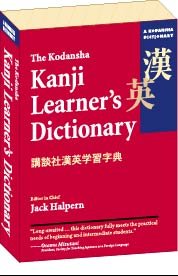
If you are a reasonably serious learner of Japanese, between beginner and upper-intermediate levels and you have not yet discovered SKIP (System of Kanji Indexing by Patterns), then it is about time you did. It cuts out the often lengthy and sometimes fruitless process of trying to find the radical of a particular kanji. Briefly, this is done by classifying kanji into four groups-those that can be divided into upper and lower portions, those that can be divided into left and right portions, those that can be divided into an enclosure and its contents, and those that cannot be divided in any logical way.
The system was originally introduced in the well-received New Japanese-English Character Dictionary, published in 1990. This new dictionary was edited by Jack Helper, the polyglot Research Fellow at the Institute of Modern Culture, Show Women's University. It is more compact than its parent volume, and thus slightly easier to handle, but still provides a wealth of information.
"This book is nearly perfect. it is very complete and comes in a very handy presentation. You can quickly find the 2000 most used Kanji and learn how to write them correctly. Besides a kanji core meaning, you learn frequent combinations with other kanji, which helps a lot for context interpretation. The layout invites you to read on, even after you found what you wanted, it is beautiful! My fear of kanji is gone. I learnt to break them down in pieces and remember them easier. "
"The SKIP system really works, and obviates the need to memorize a bunch of radicals. Stroke order and multiple meanings are provided. The only thing lacking is an explanation of the origin of each character. "
"Reading Japanese just became a viable possibility Tracking found kanji compounds is still not always the quickest thing to do (I can still mis-count numbers of strokes, etc.,) but with some patience it is possible with this dictionary to find virtually any kanji you set out hunting for. And when you find it, that's where the real value is--core meanings, rankings according to frequency of use, stroke order diagrams, and most of all a wack of compounds containing the kanji in question, regardless of where it appears in the compound. You're sure to feel empowered in your running battle with the outrageous number of kanji to be reckoned with in this nutty language. Gotta love it."
"Never has a Kanji Dictionary been so EASY! Including over 2,000 Kanji this Dictionary has it all! This Dictionary uses a new system to easily look up Kanji - and it WORKS! Each entry contains a main keyword and lists numerous uses for the Kanji, including compounds. I loved how this book also teaches you the stroke order of the Kanji. This is the Ultimate Kanji Dictionary."
" Excellent, easy to use learning book As a beginner, learning a new language is not easy. However this is one of the most effective translation books I've seen. In a very short time i was able to quickly and accurately find and understand what i needed time after time."
"Possibly the designed reference work I've ever seen? It really is a joy to use! With just a few minutes getting the hang of stroke counts, any kanji can be found with little trouble. Each character has so much information packed in, from core meanings, pronounciations, stroke order, frequency of use, Unicode, common compounds, etc, but the page design is such that the information never seems cluttered. Hiragana dictionaries are a pain to use; but with this one I often find myself flipping to adjacent pages."
Having once been awed by Spahn & Hadamitzky's opus, I was certain I'd never
ever want or need another kanji-jiten. Then, a few months back, I spotted your
KLD on a web-page somewhere, checked it out later at the bookstore and, wham!,
purchased it on the spot. What I liked best about the KLD, aside from the unique,
simple and elegant look-up system, was its adherence to frequency counts.